
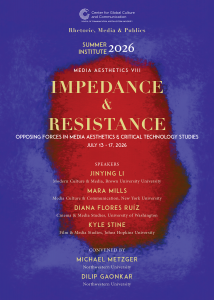
 Impedance and Resistance
Opposing Forces in Media Aesthetics and Critical Technology Studies
The eighth annual Media Aesthetics Summer Institute, organized by the Rhetoric, Media, and Publics program at Northwestern University, will be held between Monday July 13 to Friday July 17 in person on Northwestern’s Evanston campus. The theme of this year’s summer institute is “Impedance and Resistance: Opposing Forces in Media Aesthetics and Critical Technology Studies.”
“Impedance and Resistance: Opposing Forces in Media Aesthetics and Critical Technology” centers aesthetic and embodied experience in grasping the stakes of these contests. Does human perception matter at the level of the transistor or the algorithm? How does a circuit board signify? In the face of ascendant technologies like AI, must media scholars reevaluate disciplinary oppositions such as those separating aesthetic and textual analysis from inquiries into operations, formats, platforms, and hardware? Looking at both representations and their supports, we propose, in the words of Diana Flores Ruíz, to “attend to both the appearance of images and the mechanisms by which images impact sociotechnical
In electrical engineering, impedance and
Institute Format and Application Process
The institute will consist of five days of presentations and discussions led by visiting scholars and Northwestern faculty. This year’s visiting scholars include Diana Flores Ruíz (Cinema and Media Studies, University of Washington), Kyle Stine (Film and Media Studies, Johns Hopkins University), Mara Mills (Media, Culture, and Communication, NYU), and Jinying Li (Modern Culture and Media, Brown University).
This year’s Media Aesthetics summer institute will also feature one or more screenings of thematically and historically relevant film and media works, to be hosted at Northwestern’s Block Museum of Art.
The institute is sponsored by the Center for Global Culture and Communication (CGCC), an interdisciplinary initiative of Northwestern University’s School of Communication. The CGCC will subsidize transportation (up to $250), lodging (single occupancy), and some meals (breakfast and lunch every day and two group dinners) for admitted students. Applicants should send a brief letter of nomination from their academic advisor, along with a one-page statement explaining their interest in participating in this year’s institute, to the summer institute coordinator, Prerna Khobragade (PrernaKhobragade20